
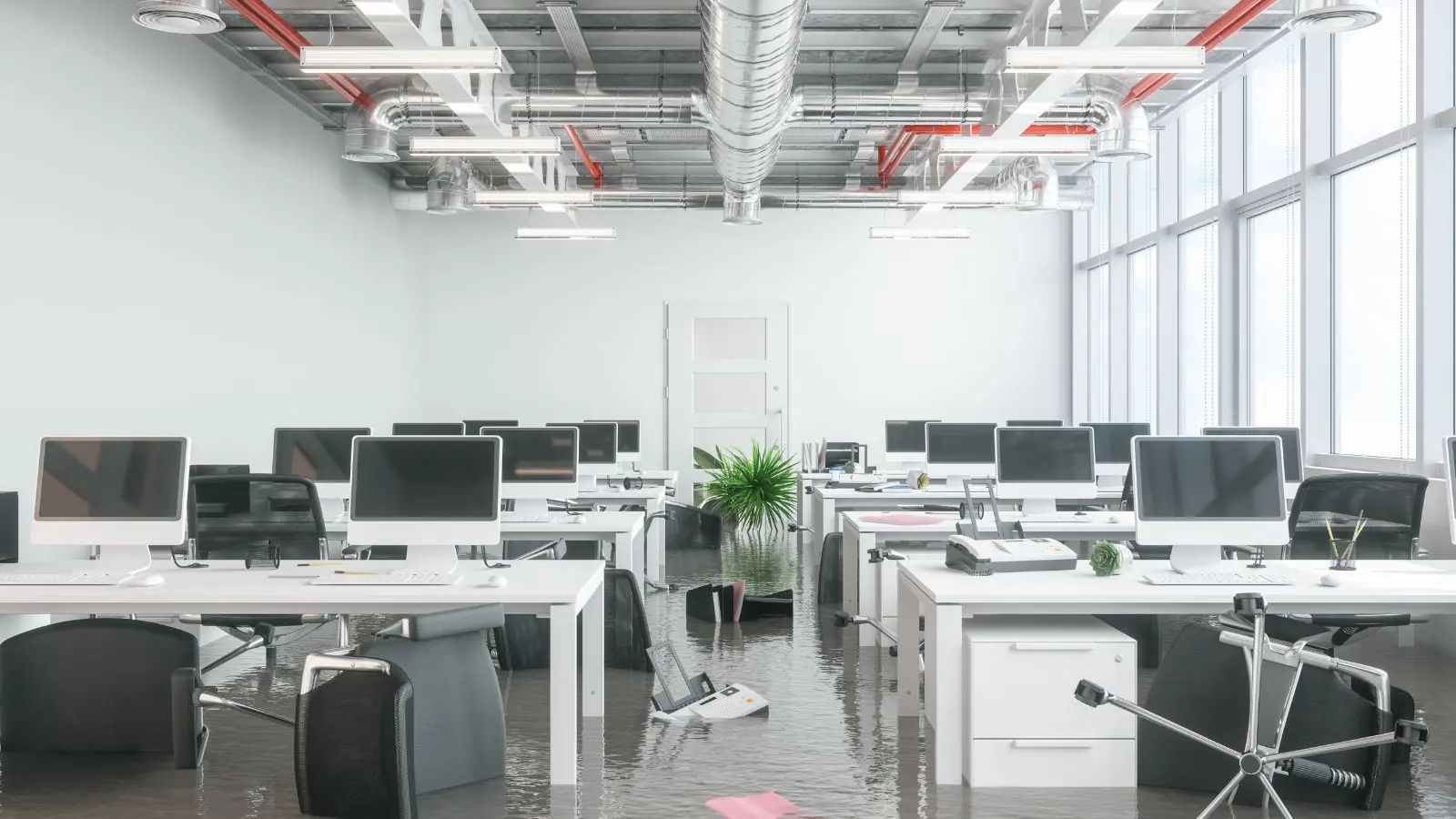
A burst line in a ceiling, a failed water heater or a storm leak can shut a business down faster than a home, because carpet, drywall, stock and equipment are all in the path. Calls for shops, offices and warehouse units around Chatsworth go to our Devonshire Street operation, and the dispatch line stays staffed around the clock. Same-day response when available.
This page covers what a restoration crew does inside a commercial space: pull out water, dry the structure, clean affected surfaces and document the loss. It also explains who usually has to be called besides us. Lease terms, repairs to building systems and rebuild work often involve more than one party.
How water damage happens in commercial space
Most commercial losses start the same way residential ones do. A supply line fails, a drain backs up, a roof lets in rain, or a fire sprinkler or water heater releases water it was never meant to. The difference is scale. Water runs under partition walls and across open floor plates, so one broken fitting can reach several suites.
Slow leaks are common too. A drip above a drop ceiling or behind a restroom wall can run for weeks before a stain shows. By then insulation, ceiling tile and the bottom of the drywall are often saturated.
What you see and what it usually means
Walk the space and look low and high. Visible signs point to where the water came from and how far it has gone.
- Sagging or stained ceiling tiles point to a leak above, from a roof, a pipe or an air handler.
- Baseboards that lift or paint that bubbles near the floor mean water is wicking up the wall.
- Carpet that squishes, or vinyl tile that curls at the seams, means water is under the surface.
- A sour smell in a closed office suggests damp material inside a wall or under flooring.
- A water meter that moves when everything is off suggests a leak in a line you cannot see.
Commercial Water Damage Restoration in Chatsworth? Call the 24/7 line.
☎ (818) 337-2642Safety in the first hour
Get people out of any area with standing water, and keep them out if the water is near outlets, panels, copiers or server racks. Close the main water valve for the building or suite. Where the breaker box is dry and easy to reach, switch off the circuits serving the soaked zone. Any doubt, a gas odor or visible sparking means walking everyone out and phoning 911 or the utility first. Our line can wait until that risk is handled.
Sewage or dark water changes the job. Do not walk through it, and do not run fans in it. Tell the dispatcher what you see when you call.
Do not stand in water near electrical equipment. If a panel, outlet or breaker is wet, call 911 or the utility first.
Our process for a commercial loss
The steps are the same ones used in homes, scaled to larger floor areas and tighter schedules.
- Stop the source or confirm it has been stopped, and make the area safe.
- Pumps and truck-mounted or portable extraction units pull the pooled water, and crews then strip out sodden ceiling tile, insulation and carpet pad.
- Moisture meters and a thermal imaging camera chart where the water traveled, one suite and one partition at a time.
- Air movers and LGR dehumidifiers go in next, with HEPA air scrubbers added whenever tear-out stirs up dust in an occupied building.
- Apply antimicrobial treatment to affected surfaces where the situation calls for it.
- Record moisture readings at each visit and keep photos, so the file is ready for a landlord or insurer.
Who is responsible: owner, tenant or property manager
In general, the lease decides who pays for what. Building systems and structure often fall to the owner, while a tenant's contents, build-out and business interruption may fall to the tenant's own policy. A property manager is usually the first call if you lease space.
Read the lease and check your policy before you assume. We can document the loss and describe the work, but we cannot decide fault. If two parties disagree, accurate photos and drying records help both sides.
What changes the cost
Every loss is priced after an inspection, because the factors vary so much. Nothing here is a quote.
- Square footage affected and how far the water traveled
- Type of water, clean or contaminated
- Carpet, tile, drywall or ceiling grid, and whether each can stay and be dried
- How many days equipment must run to reach dry readings
- Access, such as occupied suites, shared walls and loading limits
- Whether demolition and disposal are needed
Insurance fit and avoiding common mistakes
A snapped supply line or similar abrupt, accidental release is frequently covered under a commercial property policy. Slow seepage and deferred maintenance often fall outside coverage, and rising flood water generally requires its own flood policy. Check your policy, then ask your insurer what documentation it wants.
Do not throw out damaged stock or equipment until the adjuster says you may. Drying should not hold for the claim decision, since a policy may refuse later damage when reasonable protective steps were skipped. Reasonable emergency work is normally part of protecting the property, so keep receipts.
Ask about standards before work starts
The industry publishes ANSI/IICRC S500 as its written reference for professional water restoration work. Ask any company, including us, whether its crews work to it and how readings will be shared. A clear answer, plus a written scope, tells you a lot before the first air mover goes down.
Permits, utilities and paperwork in Chatsworth
Because Chatsworth belongs to the City of Los Angeles, permits and inspections for tenant spaces and buildings go through the city's building department, LADBS. Applications are filed online through PermitLA or ePlanLA using an Angeleno account, and the work has to meet local code. If your loss involves walls, ceilings or structure, ask the contractor early who pulls the permit.
The water utility here is LADWP. If a line breaks on the street side of your meter, the utility is the right call for the shutoff, and a leak on your side is handled by a plumber.
The state insurance department's homeowner claims guide suggests itemized written bids from licensed contractors for structural repairs, plus a call log and copies of every letter and email. The same habits help a commercial claim. If you manage buildings in nearby Winnetka or Canoga Park, keep one set of records per property.
Frequently asked questions
Is emergency commercial water damage restoration available in Chatsworth, CA?
Yes. Someone answers at all hours, nights, weekends and holidays included. Call, describe what you see, and the dispatcher will schedule a crew. Same-day response when available. While you wait, close the water valve, keep people out of wet areas near electrical equipment, and move stock, paper and electronics off the floor if it is safe.
Do you work on both owner and tenant spaces?
Yes, the drying and cleanup work is the same either way. What differs is who authorizes it. Tenants usually need approval from the landlord or property manager for work on walls, ceilings and building systems. Contents and build-out are often the tenant's concern. Check your lease, and we can document conditions for whoever is responsible.
Can my business stay open during drying?
Sometimes. Equipment is loud and cords and hoses cross floors, so a crew often isolates the wet area from the rest of the space. Whether you can stay depends on how much of the space is wet, the water type, and safety. Contaminated water means the area should be closed. The crew will tell you what is practical after inspecting.
How do you document a commercial loss?
The crew takes photos of the damage and the equipment layout, and records moisture readings from a moisture meter at each visit. Those records show where the water went and when materials reached dry readings. Keep your own list of damaged contents with brand and model. Ask your insurer what format it prefers before the adjuster visits.
Who fixes the pipe, roof or building system that caused the leak?
A licensed plumber, roofer or HVAC technician handles the repair. A restoration crew dries and cleans up the damage the leak caused. Often both are needed, and the order matters. The source should be stopped first so drying is not undone. For related causes, see burst pipe water damage and roof leak water damage.
What happens if sewage or dirty water is involved?
Treat it as a hazard. Keep people out, do not run fans, and do not touch affected material. Contaminated water means porous materials like carpet, ceiling tile and insulation usually have to be removed instead of dried. Crews wear protective gear and use antimicrobial treatment after removal. Mention it on the call so the right plan is ready.
Will mold be a concern after a commercial water loss?
Mold needs moisture, so fast drying limits the risk. If wet material sits for long, mold can start. Nobody can promise it will never appear. Should you spot or smell growth, the S520 standard guides how testing and remediation are done. Health questions belong to a physician. See our mold remediation page for the process.
Water on the floor right now? Call the 24/7 line.
☎ (818) 337-2642